Construction Debris Disposal That Keeps Your Goldsboro Job on Schedule
Every remodel, tear-down, and ground-up build in Goldsboro throws off a steady stream of construction and demolition (C&D) debris, and how you handle it decides whether your crew spends the day building or babysitting a pile of scrap. Whether you are framing new subdivisions off Buck Swamp Road, turning units near Seymour Johnson Air Force Base, or gutting a storefront as part of downtown Goldsboro's revitalization, a disposal plan built around the right containers, honest weight math, and Wayne County's disposal network will protect your margins and keep you compliant with North Carolina rules. This guide walks Eastern North Carolina contractors through sorting C&D waste, separating heavy inert material, hitting weight limits, recycling what the local market will take, and documenting diversion when a spec calls for it.
Know Your C&D Waste Streams Before the First Load
Construction and demolition debris is not one material; it is a dozen different ones that behave very differently in a roll-off. Treating them all as "trash" is where budgets go sideways. On a typical Goldsboro job you will deal with several distinct streams, each with its own weight profile and disposal path:
- Drywall and gypsum — light but bulky, and a diversion target because gypsum breaks down into sulfur compounds in a wet landfill. New-construction scrap is clean and recyclable; painted or moldy board is not.
- Dimensional lumber and engineered wood — clean framing offcuts, OSB, plywood, and pallets. Clean wood is one of the easiest materials to divert; treated, painted, or glued wood is handled as general C&D.
- Brick and masonry — heavy, inert, and often reusable or crushable into aggregate.
- Concrete — slabs, footings, sidewalk, and block. The heaviest thing on most sites and the single material most likely to blow your weight allowance.
- Roofing — asphalt shingles, felt, and tear-off. Shingle debris is dense and loads weight fast on the humid coastal plain, where tear-offs hold moisture over a weekend.
- Siding — vinyl, fiber cement, and metal. Metal siding and trim have scrap value; vinyl and fiber cement usually ride as general C&D.
- Cardboard, packaging, and insulation — high-volume, low-weight material that fills a box fast and is worth keeping out of your heavy bin.
The first move on any project is to walk the scope and estimate each stream so you can plan containers instead of reacting to an overflowing box on Friday afternoon. Our guide to what can go in a dumpster breaks down the materials that are banned outright and the ones that need special handling.
Separate Heavy Inert Debris from Everything Else
The most important sorting decision on a C&D site is the split between heavy inert material — concrete, brick, block, asphalt, dirt, and rock — and the lighter mixed debris of wood, drywall, roofing, and packaging. Mixing them is the fastest way to turn a routine haul into an overweight charge and a disposal headache.
Inert debris is dense. A single 20-yard box can hold enough broken slab to exceed the legal road weight of the truck long before the container looks full. Light mixed debris is the opposite: it fills the cube and tops out on volume well before it threatens a weight limit. When you throw both in the same bin, you either leave expensive air space above heavy material or you bury a weight bomb under a mountain of drywall. Dedicating a bin to each stream lets you load concrete to a safe weight in a small, dedicated container and fill a larger box with bulky light debris.
Why Concrete, Brick, and Dirt Need Dedicated Bins
Haulers and landfills price and permit heavy inert loads differently for a simple reason: a cubic yard of concrete can run 3,000 to 4,000 pounds, and a cubic yard of wet dirt is similar. Fill a 30-yard box with slab and you are looking at 40-plus tons — far beyond what any roll-off truck can legally and safely carry on North Carolina roads. That is why clean concrete, brick, block, asphalt, and soil almost always go in a dedicated 10- or 20-yard container with a strict fill line, often priced by the ton. Keeping those loads clean also matters: a concrete bin with no wood, rebar overhang, or trash in it can go straight to a crushing or recycling facility instead of the landfill, which is cheaper for you and better for the project's diversion numbers. If your scope involves significant slab removal, footings, or hardscape demo, talk to us about concrete and heavy debris service before you order a single box.
Weight Limits and How They Shape Your Container Plan
Every roll-off rental includes a weight allowance, and anything over it is billed per ton. Those overage fees are not a penalty the hauler invented to nickel-and-dime you — they reflect real tipping fees at the scale and real limits on what a truck can legally haul. Understanding the math keeps surprises off your invoice.
A mixed C&D load of wood, drywall, and shingles will usually fill a 20- or 30-yard box to the top while staying inside a reasonable tonnage. Dense material changes that calculation completely. Roofing tear-offs, plaster, tile, and masonry can hit the weight ceiling at the half-full mark. The practical rules for Eastern NC job sites:
- Load heavy and inert material in the smallest practical container, and never fill a large box with concrete or dirt.
- Keep roofing tear-offs in their own 20-yard box — shingles are deceptively heavy, and coastal-plain humidity adds water weight to a tear-off that sits over a weekend.
- Distribute weight evenly and keep everything below the top rail so the box is legal and safe to haul.
- Ask up front what the included tonnage is and what the per-ton overage runs so you can price disposal into the bid accurately.
What Recycles in the Goldsboro Area
Diversion is not just a green talking point in Eastern North Carolina — for many materials it is cheaper than landfilling, and for some projects it is required. The Goldsboro and Wayne County market supports recycling of several common C&D streams when they are kept clean and separated:
- Clean concrete, brick, and block can be crushed into reusable aggregate rather than buried, which is why a clean inert bin is worth the discipline.
- Scrap metal — copper, aluminum, steel studs, metal siding, HVAC units, and rebar — carries real market value at area scrap yards. Pull it out and it pays instead of costing.
- Clean dimensional lumber and untreated wood can be ground for mulch or reuse where a market exists.
- Cardboard and packaging from new-construction deliveries recycle easily and keep volume out of your paid box.
- Clean gypsum drywall scrap from new work is recyclable in some markets; confirm current acceptance before you plan around it.
Because acceptance and pricing shift with the commodity market, the smart play is to confirm what is moving before the job starts. We stay current on what the Wayne County facilities and regional processors are taking and can set up your container plan to capture it. Reach out through our contact page and we will walk your scope with you.
Staying Compliant with North Carolina DEQ and Wayne County Rules
North Carolina regulates C&D disposal through the Department of Environmental Quality (DEQ), and the rules have real teeth. A few that matter on every Goldsboro job:
- Banned materials. North Carolina prohibits certain items from landfill disposal, including whole scrap tires, lead-acid batteries, white goods (appliances), used oil, and yard waste in many cases. These cannot ride in a C&D roll-off and must be routed to the proper handler.
- Regulated and hazardous materials. Asbestos-containing material, lead paint debris, and other hazardous waste are strictly controlled. Pre-1980 structures in downtown Goldsboro and older farm buildings are prime candidates for asbestos and lead, and both require testing and licensed abatement before demolition — they never go in a standard dumpster.
- Approved facilities only. C&D debris must go to a permitted C&D landfill, transfer station, or recycling facility. Illegal dumping or open burning on a coastal-plain lot carries steep penalties and can stall your project.
Wayne County operates the disposal infrastructure that most Goldsboro jobs rely on, including the landfill and transfer station network and permitted C&D facilities. Using a local hauler who runs these scales daily means your debris lands where DEQ requires it and your paperwork reflects it — which matters the moment anyone asks for proof.
Job-Site Container Logistics on Coastal-Plain Subdivision Lots
Goldsboro's flat, sandy coastal-plain lots are generally forgiving for roll-off placement, but there are regional details worth planning around. Set these up right and the box becomes part of the workflow instead of an obstacle:
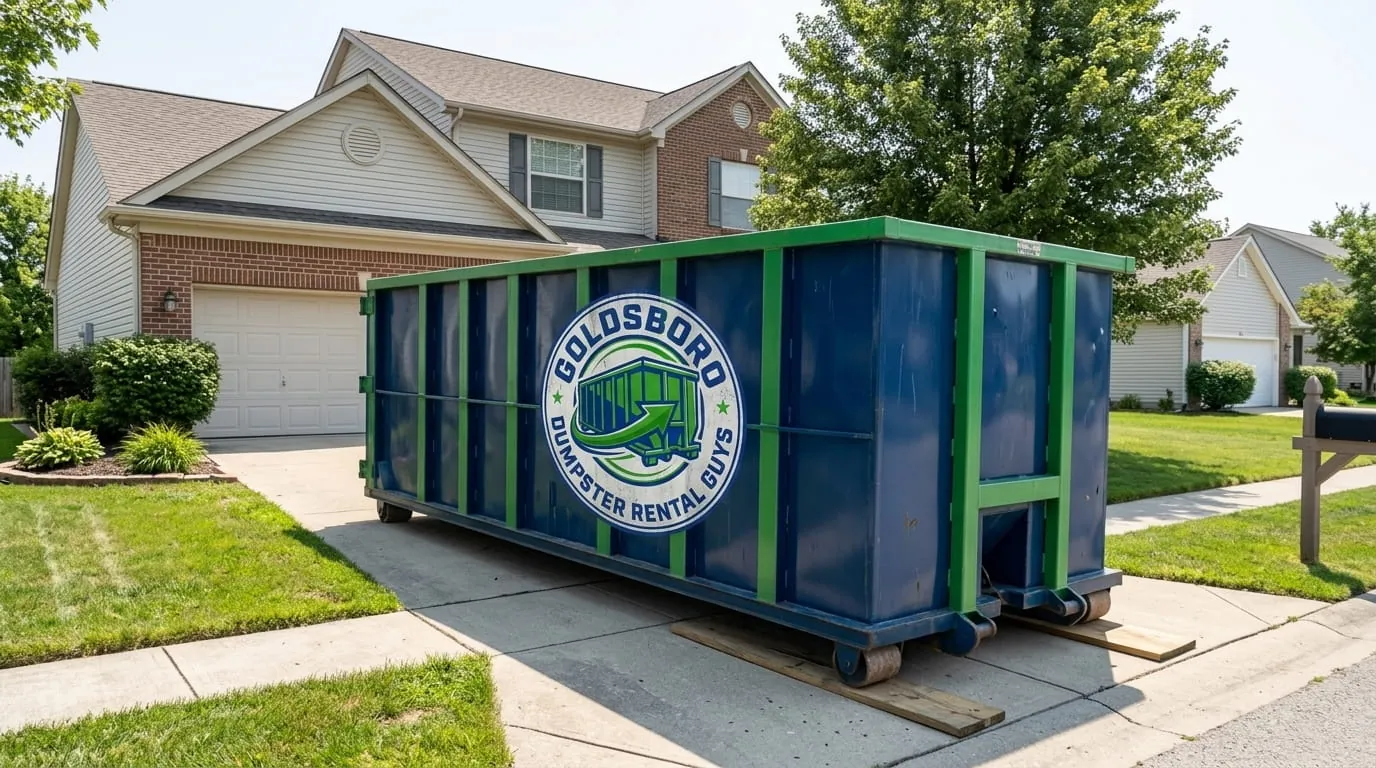
- Protect the pad. Flat lots are easy to drop on, but soft, sandy, or freshly graded ground gets chewed up under a loaded box and a delivery truck. Plywood or boards under the container protect the surface and keep the box from settling.
- Plan for drainage and rain. Eastern NC gets heavy rain and the occasional tropical system. Open-top boxes collect water that adds weight, and low spots on a flat lot pool fast. Position bins on the high side and keep tear-off and gypsum out of standing water.
- Keep the swing clear. Roll-off delivery needs a straight, clear approach and overhead clearance free of the power and cable lines common in established Goldsboro neighborhoods and downtown alleys.
- Stage for the trade sequence. Place the box where framers, roofers, and finish crews can all reach it without walking debris across finished work, and plan a swap-out schedule so a full box never stops production.
- Mind access near base and downtown. Jobs around Seymour Johnson AFB and in the downtown core can involve tighter access and gate or right-of-way considerations; confirm placement and any permit needs before delivery day.
On larger subdivision and farm-building projects, running a multi-box plan — one inert bin, one mixed C&D box, and a metal pile — keeps sorting effortless for the crew. Our construction dumpster rental service is built around exactly this kind of job-site logistics.
Diversion and LEED Documentation Basics
If you are building to LEED or another green standard — increasingly common on institutional, military-adjacent, and commercial work around Goldsboro — waste diversion is scored and has to be proven. The core idea is simple: divert as much C&D debris from the landfill as possible, and document the tonnage. A few fundamentals:
- Source separation — dedicated bins for concrete, metal, wood, and cardboard — produces the cleanest, most defensible diversion numbers.
- Diversion is tracked by weight, so you need scale tickets and facility receipts for every stream, both recycled and landfilled.
- A hauler who provides weight tickets and clear destination records makes the documentation almost automatic; one who does not leaves you reconstructing it from memory at closeout.
Even on jobs with no formal green requirement, the same discipline lowers cost: every ton you divert to a recycler or scrap yard is a ton you are not paying landfill tipping fees on. For a full demolition where separation on a tight lot is not practical, a single mixed stream may still be the right call — our demolition debris removal crews can advise on where the line between sorting and speed falls for your project.
Match the Right Dumpster to the Job
The disposal plan comes together in container selection. For most Goldsboro remodels, interior gut jobs, and roofing tear-offs, a 20-yard box hits the sweet spot for mixed C&D. For full tear-downs, new-construction cleanup, and large subdivision or farm-building projects, a 30-yard box handles bulky light debris efficiently. Heavy inert loads — concrete, brick, and dirt — belong in a smaller dedicated container with a strict fill line. Our 30-yard dumpster is the workhorse for high-volume C&D, while a dedicated heavy-debris bin keeps your concrete loads legal and clean.
Plan your streams, separate the heavy inert material, respect the weight limits, capture what recycles, and keep your paperwork clean — do that and construction debris stops being a daily fire drill. Goldsboro Dumpster Rental Guys knows the Wayne County facilities, the North Carolina DEQ rules, and the realities of Eastern NC job sites. Call us at (984) 305-2117 and we will build a container plan that keeps your crew productive and your project compliant from the first load to final cleanout.

Owner, Goldsboro Dumpster Rental Guys — sharing straight advice from years of local hauling across Goldsboro and Wayne County.
Frequently Asked Questions
Can I put concrete, brick, and dirt in a regular construction dumpster in Goldsboro?
No. Heavy inert material like concrete, brick, block, and dirt should go in a dedicated, usually smaller container with a strict fill line, because it is dense enough to exceed a truck's legal road weight long before the box looks full. Mixing it into a general C&D box leads to overweight charges and can keep clean material out of a crushing or recycling facility. Order a separate heavy-debris bin for inert loads and keep your mixed debris in its own box.
What construction materials can I recycle in the Goldsboro and Wayne County area?
When kept clean and separated, several C&D streams recycle in the area: clean concrete, brick, and block can be crushed into aggregate; scrap metal such as copper, aluminum, steel studs, and rebar has real value at local scrap yards; clean untreated lumber and cardboard are easily diverted; and clean gypsum drywall from new work recycles in some markets. Because acceptance and pricing move with the commodity market, confirm what regional facilities are taking before the job starts and set up dedicated bins to capture it.
What construction debris is banned from North Carolina landfills?
North Carolina DEQ bans several items from landfill disposal, including whole scrap tires, lead-acid batteries, white goods (appliances), used oil, and yard waste in many cases. These cannot ride in a C&D roll-off and must be routed to the correct handler. Regulated hazardous materials such as asbestos-containing material and lead paint debris are also strictly controlled, require testing and licensed abatement before demolition, and never go in a standard dumpster.
Why do I get charged extra for weight on my dumpster rental?
Every roll-off includes a weight allowance, and anything over it is billed per ton to cover the tipping fees charged at the scale and the legal weight a truck can carry. Dense materials like roofing shingles, masonry, tile, and plaster hit the weight ceiling quickly, sometimes at the half-full mark. Ask up front what tonnage is included and what the per-ton overage runs, load heavy material in the smallest practical container, and keep concrete and dirt out of large boxes to control costs.
What size dumpster do I need for a construction or demolition project in Goldsboro?
For most remodels, interior gut jobs, and roofing tear-offs, a 20-yard box is the sweet spot for mixed C&D debris. For full tear-downs, new-construction cleanup, and larger subdivision or farm-building projects, a 30-yard box handles bulky light debris efficiently. Heavy inert loads of concrete, brick, or dirt belong in a smaller dedicated container with a strict fill line. If you are unsure, call (984) 305-2117 and we will size a container plan to your scope.